

With the advent of TikTok Shop and retailers like Temu and Shien, there is a plague of hyperconsumerism upon us, something that has been vocally frowned upon by… pretty much everyone. Fox News boomers and insufferable millennial environmentalists stand united on this one issue: stop buying mountains of plastic Chinese crap when your current possessions are perfectly fine.
And yet, on April 7, the biggest retailer in the world, Amazon, sent an email to customers who own Kindle devices released in 2012 or earlier. They told users who have been hanging on to perfectly good (and in many ways, superior to new models) ereader devices that starting May 20, those devices will no longer be able to purchase, borrow, or download new books. If a device needs a factory reset for any reason after that date, it’s bricked permanently. It cannot be re-registered.
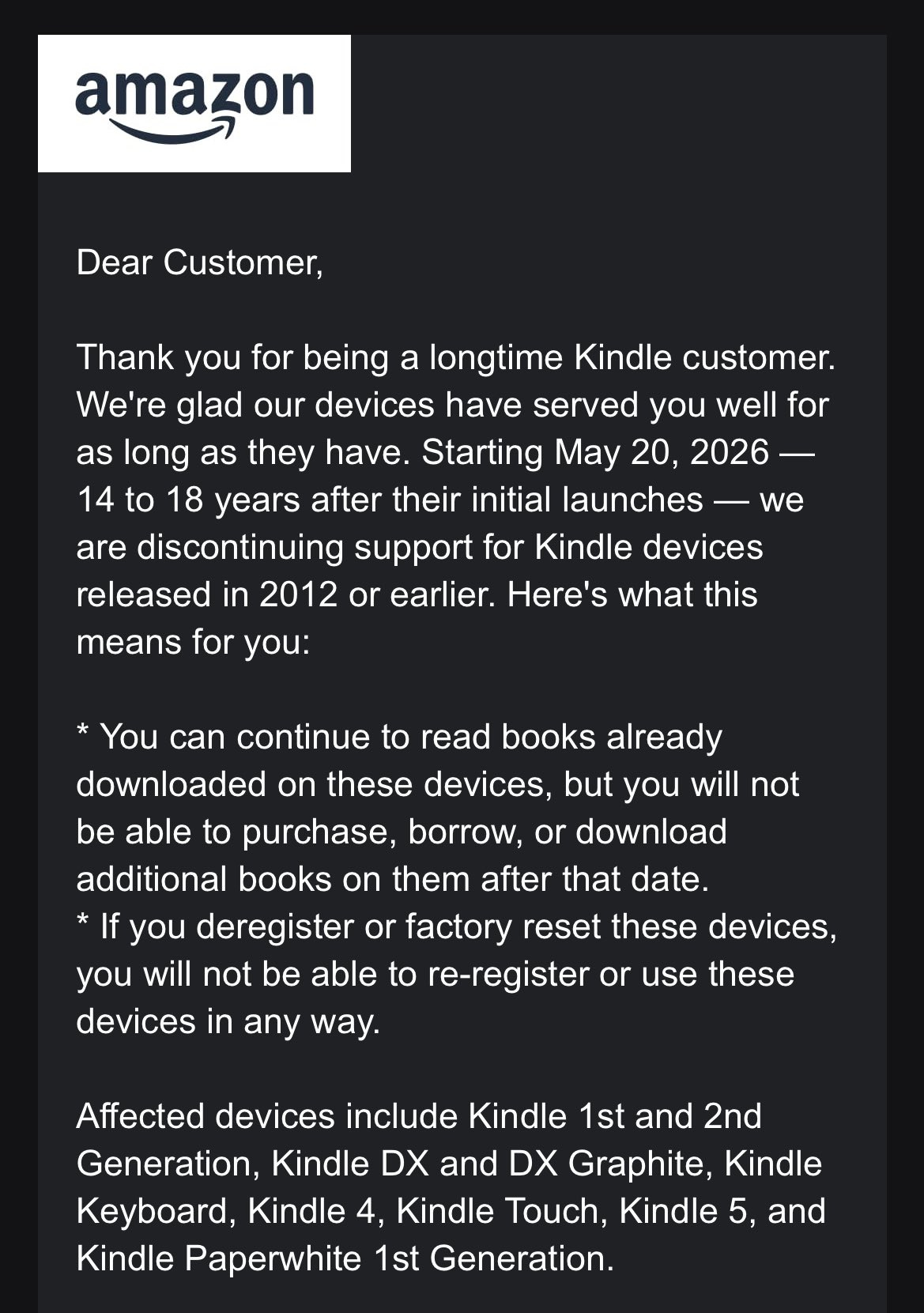
The outrage was swift and justified. If you didn’t know, you can’t make ebook purchases on the Kindle app on your phone or tablet. Why? Because Amazon doesn’t want to give a cut to the Apple/Google store. That’s part of the appeal of the Kindle: buying books right from the device.
But now, that functionality will be taken away, even though the devices themselves still work. Perfectly.
One owner on X wrote that his Kindle Fire 7, a gift from his wife over a decade ago, was one of his most treasured possessions. “It wasn’t hurting anyone. It just sat there and worked every time I asked.” Most were less polite.


Amazon’s consolation prize for bricking god knows how many perfectly good devices for no damn reason was to offer a 20 percent discount on a new Kindle. As one customer pointed out, a discount on something you hadn’t wanted to buy in the first place is not exactly a good deal.
And back to the hyperconsumerism issue, Amazon pulling this crap is especially rich given that the company co-founded The Climate Pledge in 2019, committing to net-zero carbon by 2040, and has made waste reduction and recyclability central to its public sustainability brand. Their sustainability page explicitly talks about programs for customers to repair, resell, recycle, and repurpose products, and they brag about an 85% landfill diversion rate.
Jeff Bezos personally created the Bezos Earth Fund with a $10 billion commitment, calling climate change “the biggest threat to our planet.”
All that talk about minimizing waste, and now the Restart Project, an electronics repair organization, estimates this decision could generate over 624 tons of e-waste.
But the waste, while cartoonishly hypocritical, is the secondary story. The primary story is the complete degradation of what the word “buy” means in 2026. And the answer, increasingly, is: nothing.
It’s All Rented (And Without Renter Protections)
I did a video a while back talking about downloading the books in my Kindle library, a feature that is sadly no longer available. I talked about how when you purchase an ebook from Amazon, you’re not buying a book. You are licensing access to a file, stored on Amazon’s servers, readable on Amazon’s hardware or Amazon’s apps, for as long as Amazon decides to let you. The same is true of nearly every digital storefront you interact with. Apple, Google, Audible, PlayStation, Steam. The “Buy Now” button is the most successful piece of marketing copy ever written, because it describes a transaction that is not happening.
This is old news to anyone paying attention, but most people are not paying attention until the moment their stuff disappears. Ubisoft pulled that trigger in 2024 when it shut down servers for The Crew, a racing game people had paid full retail price for. The company delisted the game, revoked digital licenses, and closed the servers. A perfectly functional single-player experience became unplayable because the publisher decided it was done. California responded by passing AB 2426, which requires digital storefronts to disclose that customers receive a license, not ownership, when they click “buy.” Well I’ll be damned, California did something right instead of heinous.
Sony nearly pulled purchased Discovery Channel content from PlayStation libraries before caving under pressure. Google has a graveyard of killed services so large that someone built a website to catalog them. And now Amazon, the company that started as a bookstore, is remotely disabling the devices people read books on.
No matter what the product is, companies are setting it up so that they can take it back from you at any time, up to and including the physical devices you bought and keep in your home.
The 2004 Standard
I joke about wanting to go back to the late 90s, early 2000s, but I am increasingly serious about it. In 2004, you owned your music. You had that massive CD wallet you kept on the passenger seat, or if you had a fancy new model, you could plug in your iPod and listed to the MP3s you ripped yourself. Yes, you could actually listen to music without being connected to WiFi or 5G.
You owned your movies. DVDs. Physical discs that played when you pressed a button, regardless of whether the studio still liked you. You bought books at a store. The store could close and your book would still be on your nightstand.
The supposed convenience revolution of the last twenty years seemed exciting when all this new shit was rolling out.
“Omg a camera, an MP3 player, and a phone—all in the ONE device!”
“Wait, I can watch Netflix movies without waiting for a new DVD to arrive in my mailbox? Amazing!”
We hadn’t yet realized what was in those Terms of Service agreements we just blindly clicked through: You don’t own shit (and also we can spy on you).
I have been rebuilding my ownership recently. My life is too noisy with too much crap screaming for my attention, my money, and the mental energy to scroll through endless options. So I have returned to physical books (working my way through my existing ebooks that I bought and never read). I buy DVDs again, starting with the complete series of Star Trek: Deep Space Nine. We have a used physical media store nearby and I’m looking forward to browsing.
I have downloaded every audiobook and ebook I previously “purchased” through digital platforms, and going forward, I will only buy DRM-free digital products. I know I own them because I hold the file. It doesn’t matter if there’s internet and no one can snatch back the book I bought, even if the author/publisher runs afoul of Amazon’s good graces.
I canceled Hulu and Disney Plus this week. I never thought I would do that. But the content libraries shrink while the prices climb, and I realized I was paying a monthly fee for the privilege of watching the same four animated movies whenever I was feeling down, as well as Family Guy reruns to fall asleep too.
Not exactly a good consumer decision.
I also got a library card last week. I haven’t had one in well over a decade. But going in that place and just smelling the books was truly soul healing.
We were never meant to spend our lives staring at phones.
Finding The “Stuff” That’s Actually Yours
If this latest bullshit from Amazon has inspired you to leave the Kindle ecosystem, that doesn’t mean you have to give up e-ink reading. Several dedicated e-readers exist that aren’t tethered to any single storefront, and they read standard epub files out of the box.
Kobo, owned by Rakuten, supports epub natively, integrates directly with library borrowing through OverDrive, and features a customizable warm light. The Kobo Libra Colour is my preferred device and I’ve heard good things about the Kobo Clara BW. You can load any DRM-free epub or PDF onto them without conversion, without an account with any retailer, and without anyone’s permission. (You can also make purchases from the Kobo store. Just be advised this is a Candian business and everything is more expensive, and the books you “buy” will have DRM and thus you will not actually own them).
The Boox Palma 2 is a phone-sized e-reader that runs full Android and doesn’t lock you into any specific ecosystem. Because it runs Android, you can install any reading or audiobook app you want, including the ones listed below. It fits in a pocket and functions as a dedicated reading device without the attention-destroying features of a phone.
For those who prefer reading on their phone or tablet, you don’t need the Kindle app or Apple Books. Several independent epub reader apps exist for both iOS and Android that will read any DRM-free file you own. Moon+ Reader (Android) is highly customizable with gesture controls and annotation support. FBReader (iOS and Android) is clean and lightweight, supports epub and several other formats, and syncs bookmarks across devices. All of these apps let you import files from your device storage, cloud drives, or via wifi transfer. No storefront or account required. (As a note, Apple Books and Google Play Books also allow you to read epub files you upload to your device).
For audiobooks, the same principle applies. If you have downloaded your audiobook files as MP3 or M4B, you need a player, and that shouldn’t require a subscription. Bound (iOS) is my preferred player. It remembers your position, supports sleep timers, and imports via AirDrop or Files. Smart Audiobook Player (Android) is the go-to for Android users, letting you select folders, control playback speed, and track listening progress across multiple books. ListenBook (iOS) supports the widest range of audio formats and includes an equalizer for listeners who care about sound quality.
The infrastructure for a fully independent reading life already exists. We don’t have to live like this.
Prioritize Authors Who Actually Sell You Something
Like I said earlier, I will only ever buy DRM-free digital products going forward. The problem is that trad-pub authors don’t control their ebook files. They genuinely don’t have the right to sell you a DRM-free copy.
Independent authors do.
A recent Written Word Media survey found that 30 percent of indie authors are already selling direct to readers, and another 30 percent plan to start in 2026. Among authors earning over $10,000 per month, roughly half sell direct. This is the fastest-growing movement in publishing, and it exists because indie authors saw the same writing on the wall that you are seeing now.
When you buy an ebook directly from an indie author’s website, you get a file. An epub or a PDF and you can put it on any device you own, on multiple devices even. Nobody can take it back from you and unless you fall for one of those “IT support” scams, no one can brick your computer or tablet and force you to buy a new one. You bought a book. That means you own a book.
Tools like BookFunnel and Payhip make this process painless for authors and readers alike. Add to that, the author keeps more of the money. Everyone benefits except the middleman, and the middleman is the one who just sent you an email explaining why your perfectly functional reading device is about to stop working.
If you care about owning the books you pay for, buy from authors who sell direct. They are the only ones in the supply chain who can actually give you what Amazon pretends to sell.
Great article, BS they’re doing… but I learned that lesson many moons ago. You haven’t been able to buy the original Star Wars movies in 30 years… buy the paperback, buy the dvd, buy the record.
I make leather bound copies of my books. One of them, the text has never seen the internet, has never been on a computer connected to the internet.
The future is what you can hold in your hand. Not surprising Amazon is shutting down older Kindles. Great info here, about how to own books, not rent them from corporations.