
The Scamification of Fiverr
Where freelancers are the product and the customer

A couple weeks ago, the algorithm gods over at Twitter gave us two gifts: universal translation of posts to English, and the ability to georestrict the replies. Meaning when you posted, you could block certain countries or regions from replying.
You know exactly which two regions got blocked in most big accounts’ comments sections and the affected countries were NOT happy. About any of it. Not happy their botted slop couldn’t appear in comment sections, not happy that the algo mostly kept their visibility restricted to their own countries, and definitely not happy about foreign slop accounts getting suspended for pretending to be an American housewife in a MAGA hat.
The wailing that ensued was glorious… in an annoying way. “I don’t WANT to talk to people in my own country! Why shouldn’t I be ALLOWED to comment on American politics?”
Excuse me, but access to Americans is not a human right, yet it has become clear that the rest of the world thinks it is, even as they vocally revile us.
As an author, service provider, or business owner, the give and take of online reach is slightly different than it is on the consumer end. But what has now become clear is that doing business on the internet is becoming increasingly controlled by foreign interests, and it’s having an effect on everyone who spends or makes money on the internet.
Basically everyone.
I bring this up because, over on YouTube, I’ve started releasing chapters of my audiobook, Paid by the Word, which is a guide for writers who want to start a services business to fund their art. I wrote it back in 2024 and, since then, things have changed (obvi). One of the biggest changes is the state of Fiverr, a major freelance platform, where I have been attracting clients for many years. It’s the platform that gave me the freedom to get away from the bullshit agency I worked for. In essence, it’s the site that got me where I am today.
So the criticism I level in this article is not something I take lightly. It’s a public service for other writers who offer services, and for anyone who wants to hire a service provider.
Micro-Level Indignities
Every platform has its own unique enshittification journey, and like the rest, Fiverr’s started with little annoyances. Like the third-world assault on my response rate stats.
For clarity, I am required to respond to every message that comes in my Fiverr inbox (unless I mark it as spam). If I drop below a 90% rate, I risk losing my top seller status, which took me years to get. You are selected for this level; it’s not automatic like Level 1 and Level 2 are. And the best clients ONLY work with US-based Top Sellers. So it goes without saying, it’s worth jumping through hoops for.
The problem is the number of hoops has consistently increased over the years. More and more spam messages. More and more of them wrongly included in my 90-day stats.
In order to correct the issue, I used to be able to send a support ticket (email) directly. Now I have to get through the chat bot who insists it needs to “provide me with resources” before it can put in a ticket.
I’m obliged to take sass from a clanker.
So I order the damn thing to put in a support ticket, which it does, sending the email that I used to send myself.
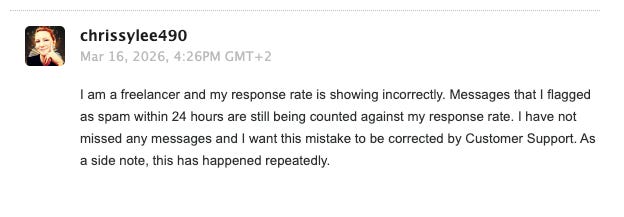
Fiverr Customer Support got back to me fairly quickly (they always do, props to them) and let me know the problem:
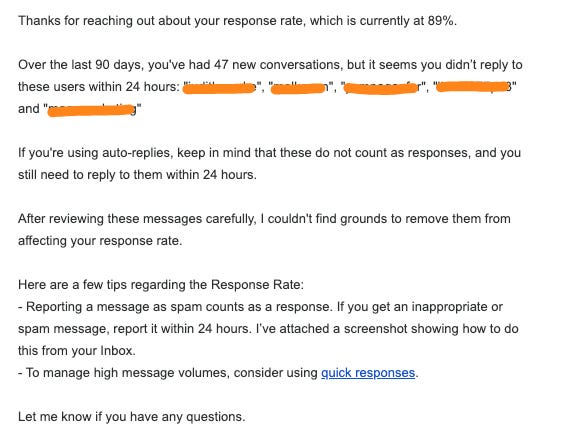
Okay, now I’m angry. I know that’s BS. I COUNTED how many unanswered messages I had, and it was precisely one. So I went through and took screenshots of the offending messages:
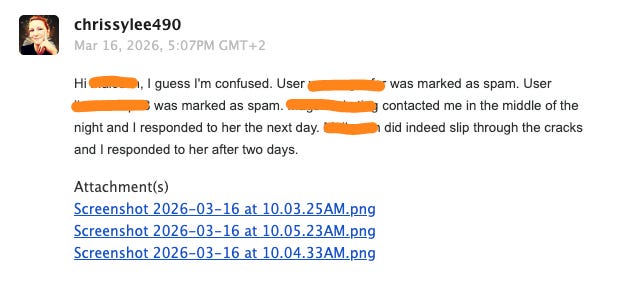
The Fiverr rep replied with apologies and removed the two marked as spam from my stats, putting me over the 90% threshold.
But… why am I still being penalized for the UK-based author who messaged me at 1 am (and had a decidedly not-British name)? My plans for the following day did not involve being at the computer until the afternoon. I am a FREELANCER. You fuckers don’t dictate my schedule.
But apparently, yes they do.
And to be clear, Fiverr does have an autorespond option…
But autoresponses don’t COUNT as real responses. You’ll still get dinged.
This nonsense took up over an hour of my time, all while knowing I would have to do it again next month.
Why is there so much spam in the first place?
My experience is not unusual. Nor is it confined to Fiverr. It’s the same reason I’ve all but left Twitter, my previously most beloved time suck. They know who the problem is. The ones sending spam messages. The ones ordering services and then demanding refunds AFTER they’ve received the final files. The ones who harass freelancers across multiple platforms, sometimes driving them off the internet entirely.
And the ones who offer shitty, fraudulent services, which sites like Fiverr then make cumbersome rules to counteract. Instead of banning the ones they know are responsible.
We all know who’s doing it. And Fiverr won’t act or allow its freelancers to act. Fiverr’s own community forums tell the same story over and over. One seller reported 22 scam accounts targeting their inbox in a single day, tanking their response rate by 67%. Another watched their rate drop from 100% to 25% overnight after launching a new gig. The pattern repeats across thousands of posts: waves of fake accounts (usually pushing sellers toward Telegram or WhatsApp) flood inboxes while the spam filter catches some and misses others. Sellers lose stats they spent months building and have to beg customer support to fix the damage.
Fiverr’s solution is to make each seller play defense. Report every spam message individually, within 24 hours, and hope the system credits you correctly. There is no proactive spam prevention on the platform’s end that actually works. And there is no option to restrict who can contact you by geography.
Sellers have been requesting geo-restriction for over a decade. The answer has always been no. Fiverr won’t limit who can message sellers because that would conflict with its brand identity as a global marketplace. Sorry, but I don’t want Indians and Nigerians messaging “hi” in the middle of the night. I also don’t want them pitching me their services: “I write book for you. You have book?”
I also (and this is not something I expect Fiverr to fix on their end) have very strict rules for who I work with. For instance, if a prospect on Fiverr’s first message to me is “hey, can you send me some samples?” I mark them as spam. That’s a content thief. They want to use my samples to defraud buyers, faking a skill and English proficiency they don’t have. I also don’t work with demanding assholes.
A wall of text with a list of demands, some of them in all caps, will get you spam-boxed. Why? Because I’ve been doing this for decades and I know a problem client when I see one (I devote a whole chapter to these kinds of red flags in the audiobook).
Giving sellers the ability to restrict their inbox by country (or at least by verified buyer status) would solve 90% of the issue overnight. But Fiverr has chosen to protect its global marketplace narrative instead, and sellers pay the price in lost stats, lost sleep, and lost time wrestling with customer support.
If you want that customer support experience to go faster, Fiverr has an answer for that, too. You can pay $25 a month for Seller Plus Standard, or $49 a month for Premium, which gets you priority support and a dedicated Success Manager. The company took a problem it created, declined to fix it, and then sold you a subscription to manage the fallout. That’s a business model, all right.
And btw, I do not pay for Seller Plus. I get ass-mad every time they send me another email pitching it to me.
“NOBODY CARES” A Middle Finger to their Users
It isn’t just the freelancers Fiverr openly disrespects. It’s the customers too. In October 2024, Fiverr released an advertising campaign called “Nobody Cares: The Musical.” It was an AI-generated musical number (the ad itself was made with AI, which they announced with a self-congratulatory wink at the end) arguing that nobody cares whether creative work is made by a human or a machine. Just deliver results. ROI is all that counts.
The creative industry response was exactly what you think it was. Critics called it a vile miscalculation from a company that depends entirely on human freelancers for its revenue. The SAG-AFTRA and Actors’ Equity accounts flagged it. The ad essentially told the platform’s own sellers that the skill and experience they spent years developing was irrelevant, as long as the output looked good enough to the dumb rube paying for the end-product.
Then in May 2025, Fiverr CEO Micha Kaufman sent an internal memo to his own employees. “AI is coming for your jobs,” he wrote. “Heck, it’s coming for my job too. This is a wake-up call.” Four months later, Fiverr laid off 250 employees, roughly 30% of its workforce, in pursuit of becoming what Kaufman called an “AI-first company.” He described it as a “painful reset.”
The platform’s official AI policy for sellers landed in the place you’d expect: Fiverr now permits AI use across all service categories. Sellers can use ChatGPT, Midjourney, or any other tool they want, and they are not required to disclose those tools in their gig descriptions. If a buyer doesn’t want AI-generated work, the buyer must state that preference in writing, either before placing the order or immediately after. If they don’t, no refund.
Read that again. The burden of ensuring you receive human-created work falls entirely on the buyer. The person paying for a service has to proactively demand that the service actually be performed by a person. Otherwise, the platform assumes AI is fine.
For anyone selling genuine editorial craft on Fiverr (substantive editing, developmental work, ghostwriting that requires a real voice and a functioning brain), this is a race to the bottom you never entered voluntarily. You’re now listed alongside sellers who run client manuscripts through ChatGPT, slap a quick proofread on the output, and deliver it at half your price in a quarter of the time. Fiverr has told the market that those two services are functionally identical unless the buyer knows enough to object upfront.
The Math Ain’t Mathin’
Despite all these changes, the fee structure has remained the same. Sellers still pay a flat 20% commission on every transaction. That includes tips. If a client tips you $50 because you did exceptional work, Fiverr takes $10 of it. Buyers pay an additional 5.5% service fee, plus a $3 surcharge on any order under $100. When you add it all up, Fiverr’s effective take rate on a given transaction runs somewhere between 24% and 35%, depending on order size. That’s significantly higher than Upwork’s 10% flat rate.
Meanwhile, Fiverr’s own stock has collapsed more than 35% since the start of 2026. The company is forecasting a revenue decline this year, something almost no one in the market expected. Analysts were projecting growth; Fiverr guided for a drop to somewhere between $380 million and $420 million, down from $430 million in 2025. The gap between guidance and expectation was so wide the stock sold off 20% in a single week.
So what now?
I don’t think Fiverr’s leadership sat in a room and decided to screw over freelancers. I think something more mundane happened, and more instructive if you’re trying to build a business that lasts.
Like every other platform, it’s neatly categorized under enshittification. Fiverr went public. The shareholders became the primary audience and the platform started optimizing for metrics that serve investors rather than metrics that serve users.
First it was remaining a worldwide brand at all costs, harming its honest contractors in the process. Then screwing over its customer base with the shady AI policies.
If you’re a writer selling services, or want to be, Fiverr can still be useful. I haven’t quit the platform, though I do try everything I can to find my own clients and bill them directly (thanks to YouTube for sending me awesome writers).
Fiverr is good for visibility. It has massive search traffic. Buyers looking for editors and ghostwriters will find you there before they find your personal website, at least initially. The review system, for all its flaws, provides social proof that’s hard to replicate from scratch. And for writers just starting a services business, Fiverr removes the hardest part of the early days: finding people willing to pay you.
What’s it NOT good for anymore is building a sustainable business. The 20% commission eats your margins and the spam and algorithm issues consume time you should be spending on actual work. And most critically, Fiverr owns the client relationship. If the platform changes its policies, adjusts its algorithm, or decides your category isn’t worth prioritizing (which it already has, publicly, in earnings calls), you lose access to clients you spent years cultivating. You have no email list, no direct contact.
Real talk, I recommend using your Fiverr username as your social media handle. I did that for years before YouTube took off, and it was a godsend.
The smart play is to use Fiverr as a front door. Get the client on the platform, deliver exceptional work, build the relationship through the order process, and then transition that client to your own infrastructure. Your own website, your own contract, your own invoicing, your own communication channel. Where you set the price, you control the terms, and a platform’s quarterly pivot can’t wipe out your client base overnight.
This is exactly what my audiobook “Paid by the Word” covers. It starts dropping weekly on YouTube on April 16th, five episodes that walk through how to build an independent writing services business from the ground up: how to price your work (hint: the answer is never $5), how to structure client relationships for retention, how to set up systems that let you scale without a platform taking a fifth of every dollar.
If you’ve been thinking about turning your writing skills into a revenue stream that funds your fiction, or if you’re already doing it and feeling the squeeze, this is the playbook.
Like I said, use Fiverr. But build something you own. The best clients, the ones who pay professional rates for professional work and come back again and again, will follow you off the platform if you give them a reason to. Give them a reason to.
FYI: Kind of a big announcement next week. Well, medium announcement.
Freelancing, by and large, is dying on the vine. People are cheap in the US, scammy, and most important, don't value human labor. It's not worth the aggravation anymore. Let the guys from Bangladesh undercutting services by offering 5 bucks for copy work and press releases have it.
P.S. Upwork is WORSE.