Having a celebrity talk to you on social media is always a strange experience. I say always, but it’s literally only happened to me once. This month, actually.
In November, I saw a post by Variety giving a quote from actor Simu Liu, the star of Marvel’s Shang Chi and the Legend of the Ten Rings:
“Put some Asians in literally anything right now. The amount of backslide in our representation onscreen is f---ing appalling. Studios think we’re risky.”
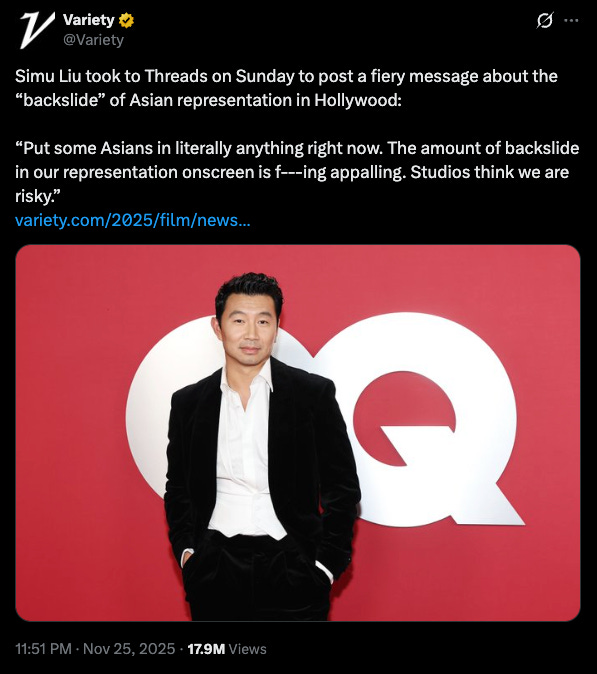
My immediate reaction was an eye-roll.
I don’t like race-first advocacy. “We need more BLACK stories. We need more ASIAN stories!” Should I, a child of Oklahoma, demand more dustbowl redneck representation? If I did demand such a thing, you might rightly ask why those stories, specifically, must be told in greater numbers. Shouldn’t stories just be good, in all the variety that comes with quality?
I also just don’t like Simu Liu. Which is why I felt moved to make a bitchy tweet about him.
When I saw his complaint, I quote-tweeted Variety: “All I’m saying is Russell Wong in his prime was hotter, more charming, with greater range, and a more impressive resume than Simu Liu could ever hope for. If we’re putting ‘Asians in literally anything,’ let [it] be silver fox Russell Wong. Both the crew and the audience will thank you.”
And, hell, why wouldn’t I? He wasn’t gonna see it. My followers don’t even see most of my tweets.
Twitter is fun that way.
Imagine my absolute shock when, nearly a month later, the man himself responded—graciously.
“Don’t know where he is now but I’ll find something for him,” he wrote. “Loved him in Joy Luck and Romeo Must Die. No idea what the other stuff is about, but he and so many actors who came up in that era fought against insane racism and prejudice. Thx for reminding me of him!”
Oh…
Well, that response didn’t match the person I thought I knew. He had the good sense not to “punch down” at some internet rando. I appreciate it.
But the niceness of his response got me thinking. Was it possible, however unlikely, that he wasn’t completely full of shit?
Why I Don’t Like Him (and thus immediately thought he was full of it)
Before I share the rabbit hole this man’s preposterously civil response sent me down, you need to understand my starting position. I approached this investigation already disliking Simu Liu.
Here’s why:
A Principled Man… Except When it’s Inconvenient
In 2018, Simu Liu tweeted about Mark Wahlberg’s 1988 hate crime against two Vietnamese men. This is unassailably true. Wahlberg has confessed to his crimes, was punished, and made amends, both directly to his victims and publicly taking culpability. Pretty sure there was some charity/reparations involved in the apology as well.
Long after all that, Liu scathingly tweeted: “Let me get this straight, Mark Wahlberg beat a helpless Vietnamese man with a stick until he passed out when he was 16, and is attempting to get the courts to grant him an official pardon on the basis that he’s ‘turned his life around’?”
And you know what, he has the right to be mad. If he doesn’t believe Wahlberg is actually remorseful, and believes he is still dangerous to Asians… okay. #stopasianhate became a hashtag for a reason.
But in 2020, Liu was cast opposite Wahlberg in Arthur the King.
He deleted the tweet. So either he didn’t believe what he said in the tweet. Or…
His explanation, as posted on Instagram: “I deleted a couple of tweets I made regarding the past actions of one of my costars as a gesture of professionalism and to open the door to progressive conversations... Obviously it’d be pretty weird to go to work with that tweet still up.”
Speaking truth to power, it seems, only applies when it doesn’t cost you a paycheck.
The Dragon’s Den Thing
The thing that really made me dislike Simu was when he appeared as a guest investor on CBC’s Dragon’s Den (Canada’s version of Shark Tank) in 2024. Two (white) Quebec entrepreneurs pitched Bobba, a bottled bubble tea company, seeking $1 million for 18% of their business.
Liu’s behavior was, in my opinion, atrocious.
When the founders described bubble tea as a “trendy sugary drink that you queue up for, and you are never quite sure about its content,” Liu interrupted sarcastically: “I’ve never heard of bubble tea. What is bubble tea? I’ve never heard of this thing before in my life.”
He then accused them of cultural appropriation for “taking something that’s very distinctly Asian in its identity and, quote unquote, ‘making it better.’”
His demeanor was full attack-mode and the disgust with which he spoke to the non-famous business owner made me furious. Imagine pitching a business and having a world-famous celebrity, none-too-subtly, imply you’re a racist with colonial tendencies. This is the same logic that drove a Portland food truck owner out of business because she, a white woman, made burritos. It’s racist. Full stop.
Liu positioned himself as the gatekeeper of an “Asian” product that non-Asians had no right to improve or commercialize.
To his credit, when the founders received death threats after the episode aired, Liu posted a TikTok condemning the harassment: “It’s NEVER EVER okay to harass or threaten people over the internet or in person.” But his initial behavior on the show reflected the worst impulses of 2020-era woke culture—weaponizing accusations of cultural appropriation against small business owners while sitting on a panel of millionaires.
So when Simu started complaining about representation again, my instinct was to dismiss him. He’s a hypocrite. He’s a bully. He’s exactly the kind of race-first advocate I find tedious.
But… I help independent creatives pitch and publish their books (and in some cases screenplays). If Asians actually ARE being slowly but surely shut out of Hollywood, I need to be in the know about that. So I checked his claims.
And… hoo boy.
Asian-Led Films ARE Disappearing. But Why?
To specify, I am talking about films produced by western nations for western audiences. S. Korea has had several smash hit films and shows, Japanese film is robust (both animated and live action) and China and Hong Kong are pumping out reasonably good stuff too. Obviously their casts and crews are almost if not entirely Asian.
In Hollywood, however, it’s a different story. In August 2025, USC’s Annenberg Inclusion Initiative released their annual study on representation in the top 100 films. The findings were that Asian speaking characters (as opposed to extras and non-speaking roles) dropped from 18.4% in 2023 to 13.5% in 2024.
That’s a 26.6% decline in a single year. Meanwhile, white characters increased from 55.7% to 63.6% over the same period.
That being said, East and Southeast Asians are about 5.5% of the U.S. population. So they’re still overrepresented in terms of their presence in the U.S. Fewer Asian-Americans means fewer Asian actors, fewer still Asian screenwriters, and you can probably count on one hand the number of Asian-American directors.
I will refrain from making a stereotype about Asian parents’ opinions of their children who express interest in working in the performing arts.
Simu’s word choice was precise: “backslide.” The data shows he was right.
He also cited the track record of Asian-led films:
Minari: Critical and commercial success
The Farewell: Breakout hit
Everything Everywhere All at Once: Oscar winner, cultural phenomenon
Crazy Rich Asians: Highest-grossing rom-com in a decade
Shang-Chi and the Legend of the Ten Rings: $432 million worldwide
His argument: “Every single one a financial success. No Asian actor has ever lost a studio even close to 100 million dollars but a white dude will lose 200 million TWICE and roll right into the next tentpole lead.”
So yeah… he’s right. But is this a problem? What is the movie-going audience and our culture losing because of this backslide? And whose fault is it?
I went looking through his interviews, social media posts, and guest columns because I was sure he had previously blamed American audiences for racism, a la Ewan McGregor (yeah, bro, we didn’t forget about you).
But I didn’t find any.
His November 2025 statement targets “studios,” not audiences: “Studios think we’re risky.”
Likewise, in a Yahoo Finance interview, he said: “The gates are opening... we should be the ones in the decision-making process.” His targets were consistent: “screenwriters, producers, studio heads whose decisions it depends on.”
Every time I looked for Simu blaming audiences, I found him blaming executives instead.
I’m glad he recognizes that it’s an industry problem, rather than an audience problem. Because speaking as a reader and a publishing consultant, I can promise you, it’s not because the audience doesn’t like Asian stories.
A Built-In Rabid Fandom: Asian-Centric Books
The reason studios have been sticking to sequels, reboots, and novel adaptations is because it minimizes risk. Movies are so damn expensive these days (and theaters slowly but surely going under) that they want a sure thing. They want proof audiences actually want these stories. The publishing industry provides that proof in abundance.
The Crazy Rich Asians Phenomenon
Kevin Kwan’s trilogy has sold over 5 million copies worldwide. It’s been translated into more than 40 languages. In summer 2018, all three books held the top positions on the New York Times bestseller list simultaneously.
The film adaptation became the highest-grossing romantic comedy in a decade. I, a notorious rom-com hater, even went to go see it with my sister. And I loved it!
The theater was full of white girls. And black girls. And a few GBFs and partners that had been dragged along. Packed to the rafters, and it wasn’t even opening weekend.
And yet… in the Year of Our Lord 2026 (almost), none of the sequels have made it to the screen. Excuse me, what?
The Asian Fantasy Boom
R.F. Kuang’s Poppy War trilogy made Time‘s 100 Best Fantasy Books list. Her novel Babel hit #1 on the New York Times bestseller list and won the 2022 Nebula Award. Yellowface, her satirical novel about publishing industry racism, was another bestseller (tbf, that one might be a harder sell in the modern film landscape since it might be perceived by audiences as woke).
Fonda Lee’s Jade City trilogy won the 2018 World Fantasy Award and also made Time‘s 100 Best Fantasy list. Military families, political intrigue, organized crime—it reads like The Godfather meets martial arts epic.
Xiran Jay Zhao’s Iron Widow hit the New York Times bestseller list. Sue Lynn Tan’s Daughter of the Moon Goddess became a bestselling duology. Shelley Parker-Chan’s She Who Became the Sun earned multiple award nominations.
Demand for Asian stories became so intense in publishing that white authors began using Asian pen names to get book deals. When readers discovered the deception, there was massive backlash. That actually IS cultural appropriation. But think about what this means: The market demand was so high that authors looked at publishing and thought, “The only way I can compete is to pretend to be Asian.”
I’ve talked about publishing agents and their stupid little identity check boxes. But in this case, it wasn’t purple-haired trust fund babies screening for books only they wanted to read. These books were legitimate smash hits. The normies read them and liked them. And wanted more.
How, then, can any Hollywood exec pretend that an adaptation of any of these works could remotely qualify as a risk?
To put it bluntly, they’re lying.
Why? Is it because the dastardly white man wants to keep Asians in their place? Is it because (((they))) have a massive conspiracy that involves silencing the Asian diaspora?
No. I don’t think so.
What if I told you all this Asian-American suppression was occurring because the white guys in charge of Hollywood were afraid… of other Asians.
Trump was Right: It Was CHY-na
Two data points from the same time period tell the whole story:
Data Point 1: USC Study shows Asian representation dropped 26.6% (2023-2024)
Data Point 2: Box Office returns (and thus sequel potential) depend largely on whether the movie is released in China
Shang-Chi (2021): Banned in China
Eternals (2021): Banned in China
Black Widow (2021): Banned in China
Spider-Man: No Way Home (2021): Banned in China
The last MCU film released in China was Spider-Man: Far From Home in 2019.
Coincidence? Hell no.
Before 2020, China’s box office was expected to surpass the U.S. by 2020. Annual growth rates hit 40-50%. Some Hollywood films made more in China than in America. Transformers: The Last Knight flopped domestically with a $69 million opening but exploded in China with $123 million.
And don’t even get me started on the “creative decisions” made in the second Pacific Rim movie. That was a pure Chinese cash grab. The American audience who fell in love with Guillermo Del Toro’s movie were left swinging in the wind.
Hollywood became financially dependent on Chinese approval, and they remain so to this day. That means they have to keep China happy and in order to do so, they have one of three options:
Option A: Generic Asian Content (Self-Censored)
Remove anything politically sensitive (Tibet, Taiwan, Hong Kong)
Cast for Chinese approval
Result: China bans it anyway for being “inauthentic.” American audiences find it stereotypical or pandering.
Option B: Authentic Asian Content
Actually tell real stories with cultural specificity
Include political context, real history, complex characters
Result: Guaranteed China ban. Lose estimated $200-400 million in potential revenue.
Option C: Make Nothing
Safest financial choice
Don’t risk the China market
Don’t risk the cultural battles
Result: Asian representation drops 26.6% in one year.
Hollywood’s financial dependence on China—a country that IS Asian—is actively SUPPRESSING Asian representation in American films. Why? Because they don’t care about “representation.” Chinese Americans and Canadians, you think the CCP claims you? You think they see you as one of theirs? You think they want the best for you?
Not even close.
The Shang-Chi Case Study: When Doing Everything Right Still Fails
All this China stuff might be news to you. But I don’t think any of what I just said is news to Simu Liu. He was, after all, the star of Shang-Chi, a movie (arguably) made to court the Chinese market. He is also the son of Chinese immigrants. Immigrants who do not have fond memories of their homeland or of the CCP. More on that later. For now, let’s look at what Marvel did with Shang-Chi:
First Asian Marvel superhero in the MCU
Predominantly Asian cast (Tony Leung, Michelle Yeoh, Awkwafina, Simu Liu)
Extensive Mandarin dialogue, culturally authentic
Completely removed the racist Fu Manchu character from the source material
Created entirely new character (Wenwu) to avoid stereotypes
Hired Asian-American director (Destin Daniel Cretton) and writer
Enormous effort to be respectful and authentic
The box office:
$94 million U.S. opening weekend (3x the previous Labor Day record)
$432 million worldwide total
Held #1 for four weeks straight
Best pandemic-era theatrical opening
Critical acclaim across the board
China’s response was to BAN the movie.
What in the holy hell would make China ban this movie tailor-made for them? Well, I’m glad you asked. Here are their official reasons:
Source material’s racist origins still “tainted” the character—despite Fu Manchu being completely removed
Tony Leung’s past support for Hong Kong protesters
The Mandarin character still had “racist associations” despite being entirely different
One reason that was not officially cited, but was probably under consideration, was an interview Simu did with the CBC (subsequently removed), wherein he had the audacity to explain why his parents left China.
I can’t even imagine the conversations Simu had behind closed doors after Shang-Chi was banned by the CCP. Given the rumblings about Harley Pasternak, and all the Hollywood “handlers” like him, it’s safe to say that being ostracized from Hollywood may have been the very least Simu was threatened with if he ever spoke out about China again.
Simu Liu knows better than almost anyone in Hollywood exactly why studios fear Asian content—he's been personally banned by Beijing. Yet he never names the elephant in the room. Not anymore. Whether that's strategic diplomacy or something more coercive, the silence is deafening.
The Post-COVID Shift: It’s Worse Now
Before 2020, Hollywood’s strategy was to bend over for Chinese approval.
Then COVID hit. China implemented “Zero COVID.” The Chinese box office was devastated for an extended period with U.S. theaters recovering faster.
In 2022, North America’s box office hit $3.6 billion. China’s hit $2.7 billion. For the first time in years, North America pulled ahead.
China wasn’t about to allow that. Now the CCP only permits about 20 foreign films per year (down from 36 in 2018). Even heavily self-censored films get banned. China’s domestic film industry has grown strong enough that they don’t need Hollywood anymore.
The studio calculation becomes grim: “If we self-censor for China and still get banned, AND we get criticized in America for ‘pandering’ [Thanks, woke millennials]... why make Asian content at all?”
The result: Asian representation drops 26.6% in one year. We don’t get any more Joy Luck Club. We Don’t Get another Crazy Rich Asians. God forbid they let us have the sheer joy of those Jet Li/DMX movies.
Hollywood spent a decade building dependency on Chinese approval. Now that China is rejecting them anyway, instead of going back to making good stories, they’re just... making nothing.
The Bigger Picture
Do I like Simu Liu now?
Probably not. Artistic people in general can be exasperating and I doubt he’s an exception. But I have to consider—if it was me in that locked room with my agent and God knows who else threatening to take away the career I’d worked my whole life for… would I be brave enough to say, “Fuck it, we ball?”
Probably not. Because if he had said something along those lines (assuming he didn’t “hang himself”) he would not now be in a position to try and reignite Asian-led stories in western film. He’d just be “that guy who was in the Marvel movie that one time.”
Besides, on this specific issue—the collapse of Asian representation in film and who’s responsible for it—he’s absolutely correct.
This isn’t really about him at all though. This is about American studios letting the Chinese Communist Party dictate what stories get told in American cinema.
Hollywood lectures constantly about representation, inclusion, and giving marginalized voices a platform. But when it actually costs them money? When it risks their access to Chinese markets?
Those principles evaporate. Never forget what they did to John Boyega on the Chinese poster of The Force Awakens. NEVER.
The same studios that bent over backward for Chinese approval for years—erasing Tibet from Doctor Strange, removing Taiwan’s flag from Top Gun Maverick, adding Chinese product placement to Iron Man—won’t greenlight The Poppy War trilogy. Despite it being optioned by the same company that made Crazy Rich Asians a massive hit.
Cowards, all of them. And they’re willing to throw billions in potential profit away to avoid giving Beijing a well-earned middle finger.
The audience for these stories exists—you don’t need Hollywood’s permission or China’s approval. The success of Everything Everywhere All at Once (A24, relatively modest budget) proves you can succeed outside the studio system.
Stop accepting “there’s no audience” as an explanation when the books sell millions.
Stop accepting “it’s too risky” when the data proves otherwise.
Stop letting authoritarian governments dictate what art gets made in free countries.
Simu Liu (God help us all) is right: Studios think Asian stories are risky. But the risk isn’t the stories.
The risk is that we’ve given too much power to people who don’t deserve it.
It’s time to take that power back.


